
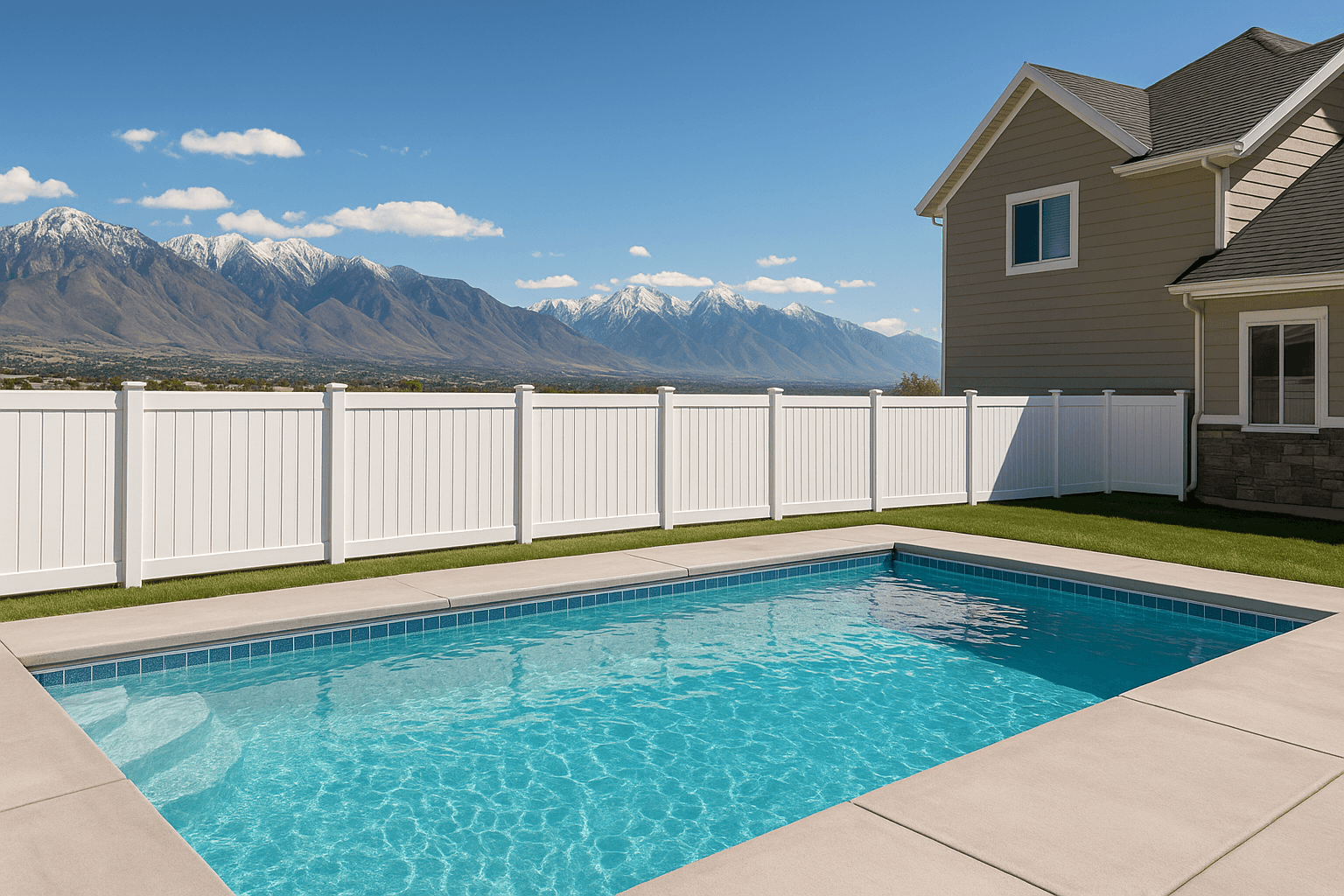
There’s nothing quite like that first cannonball into the deep end when the Cache Valley heat starts to hit, is there? But before you get too comfortable on that pool float, there’s a serious side to pool ownership that we need to address—safety, durability, and enclosure. Vinyl fencing has quietly become the gold standard for pool surrounds in Northern Utah, and honestly, it’s not hard to see why.
Contents
- 1 Let’s Talk About Safety First (Because We Have To)
- 2 Water, Chemicals, and the “Rot” Factor
- 3 Surviving the Logan Climate
- 4 The “I Don’t Want to Work on Weekends” Argument
- 5 Privacy: Creating Your Own Private Idaho (or Utah)
- 6 Comparing the Contenders
- 7 Aesthetics: It’s Not Just “Shiny White Plastic” Anymore
- 8 The Financial Picture: Upfront vs. Long Term
- 9 Is Vinyl Right for Every Single Pool?
- 10 Ready to Upgrade Your Pool Area?
Let’s Talk About Safety First (Because We Have To)
You know what keeps most pool owners up at night? It isn’t the pH balance of the water; it’s the worry about who—or what—might wander into the pool area when nobody is looking.
Here’s the thing about pool fencing codes: they are strict for a reason. In Logan and the surrounding areas, regulations usually require a fence that is non-climbable, self-closing, and self-latching. This is where vinyl fencing naturally shines. Unlike Chain Link, which is basically a ladder made of metal wires, privacy vinyl panels offer zero footholds. A toddler looking for an adventure isn’t going to find a way up a smooth, solid vinyl wall.
Plus, consider the surface itself. Wood splinters. Wrought Iron can rust and develop sharp edges over time. Vinyl is smooth. If a kid runs into it or brushes against it while playing tag on the pool deck, they bounce off rather than getting scratched up. It’s a small detail, but when you have bare skin and wet feet running around, those details matter.
Water, Chemicals, and the “Rot” Factor
Pools are wet. I know, ground-breaking observation, right? But seriously, think about what is in that water. Whether you are running a saltwater system or a traditional chlorine setup, that water is chemically active.
When you install a wooden fence near a pool, you are essentially signing up for a war against rot. The splash-out from cannonballs, the humidity rising off the heated water, and the wet towels draped over the railing all contribute to moisture absorption. Over time, wood swells, warps, and eventually rots. Iron or aluminum fences, while sturdy, can struggle with corrosion if the powder coating gets chipped, especially near saltwater pools.
Vinyl, or PVC (polyvinyl chloride), is chemically inert. You could splash chlorinated water on it all day long, and it won’t care. It doesn’t absorb moisture, which means it won’t rot, blister, or peel. It’s basically the same material used in high-grade plumbing pipes—it is literally made to handle water.
Surviving the Logan Climate
We have a unique climate here in Logan. One minute it’s 95 degrees and sunny; a few months later, we are buried under two feet of snow with temperatures dipping below freezing.
This thermal shock can be brutal on building materials. Wood expands and contracts, leading to popped nails and cracking. But modern vinyl fencing is engineered with what we call impact modifiers and UV inhibitors (like Titanium Dioxide).
Here is why that matters:
- UV Resistance: The sun at our elevation is intense. Without protection, plastic turns yellow and brittle. High-quality vinyl has “sunscreen” baked right into the material so it stays white (or tan, or gray) for decades.
- Flexibility: In high winds—and we definitely get those canyon winds here—vinyl has a certain amount of give and flexibility. It bends slightly without breaking, whereas rigid wood might snap.
The “I Don’t Want to Work on Weekends” Argument
Let’s be real for a second. You bought a pool to relax, not to add another chore to your weekend list.
If you choose wood, you are looking at staining or painting that fence every two to three years. Have you ever tried to stain a fence? It’s messy, it smells, and it takes forever. If you choose ornamental iron, you might be sanding down rust spots and repainting them to keep it looking sharp.
With vinyl, the maintenance plan is pretty complex. Just kidding—it’s a garden hose. Maybe a sponge with some mild soap if the dog jumped on it with muddy paws. That’s it.
Low maintenance is the biggest selling point for most of our customers. When you look out your back window, you want to see a pristine border around your oasis, not a peeling, graying project that makes you feel guilty for sitting down.
Privacy: Creating Your Own Private Idaho (or Utah)
Sometimes you want to show off your pool, but mostly, you probably want to swim without feeling like you’re on a stage for the neighbors.
While picket fences and wrought iron look classic, they offer zero privacy. If you are lounging on the pool deck, everyone walking their dog down the street can see you. Solid privacy vinyl fencing creates a true visual barrier. It turns your backyard into an extension of your living room.
It also blocks sound better than you might expect. No, it’s not soundproof, but a six-foot solid wall deflects a good amount of street noise and wind, creating a calmer environment inside the yard. It keeps the wind from evaporating your pool water too quickly, which actually helps retain heat and saves you money on utilities.
Comparing the Contenders
To make this a bit clearer, let’s look at how vinyl stacks up against the other usual suspects for pool fencing.
| Feature | Vinyl Fencing | Wood Fencing | Wrought Iron / Aluminum |
|---|---|---|---|
| Water Resistance | Excellent (Impervious) | Poor (Absorbs water/rot) | Good (can rust/corrode) |
| Privacy | Complete Privacy | Good (gaps can appear) | None (See-through) |
| Maintenance | Very Low (Wash only) | High (Stain/Seal/Paint) | Medium (Paint touch-ups) |
| Safety (Climbing) | Hard to climb (smooth) | Moderate (footholds) | Easy to climb (rungs) |
| Cost over 10 Years | Low (Upfront cost only) | High (Maintenance costs) | Medium/High |
Aesthetics: It’s Not Just “Shiny White Plastic” Anymore
I hear this objection sometimes. People worry that vinyl looks cheap or artificial. And, to be fair, twenty years ago, that might have been true. But the industry has come a long way.
Nowadays, we have Vinyl Fence products that mimic the grain of wood or come in matte finishes that look incredibly sophisticated. You aren’t stuck with stark white, either. You can get:
- Tan or Almond: Blends well with desert landscaping.
- Clay or Gray: Offers a modern, sleek aesthetic.
- Two-Tone: Mix and match posts and panels for a custom look.
You can also add lattice tops or decorative post caps to break up the solid wall look. It allows you to match the fence to your home’s exterior trim or siding, making the pool area look like it was part of the original architectural plan, not an afterthought.
The Financial Picture: Upfront vs. Long Term
Let’s talk money, because that’s usually where the decision gets made.
If you get a quote for a pressure-treated Wood Fence and a quote for a high-quality vinyl fence, the wood is almost always going to be cheaper upfront. That can be tempting, especially after you just spent a fortune installing the pool itself.
But you have to look at the lifecycle cost.
- Year 1: Wood is cheaper.
- Year 3: You spend $300 on stain and a weekend of labor (yours or a pro’s).
- Year 6: Another round of stain. Maybe replacing a warped board or two.
- Year 10: The wood posts might be rotting at the ground level due to moisture.
With vinyl, the check you write today is likely the last money you will spend on that fence for 20 years or more. When you factor in the cost of stain, sealant, repairs, and your own time, vinyl often becomes the cheaper option within the first 5 to 7 years. It’s an investment in your property value.
Is Vinyl Right for Every Single Pool?
Honestly? No material is perfect for every single scenario. If you live in a historic district in Logan that requires specific materials, or if you have a heavily wooded lot where a rustic cedar fence fits the vibe better, then vinyl might not be the stylistic fit.
But for the vast majority of modern residential pools, the combination of safety compliance, water resistance, and practically zero maintenance makes it the logical champion. It allows you to spend your summer swimming rather than sanding.
Ready to Upgrade Your Pool Area?
Summer in Logan is too short to spend it worrying about fence maintenance or safety hazards. You deserve a backyard that looks great and keeps your family safe with minimal effort.
At Logan Fence Company, we know exactly what it takes to build a fence that withstands Utah winters and splashing summers. Let us help you design a perimeter that complements your pool and protects what matters most.
Give us a call today at 435-383-5152.
Or, if you prefer to start the process online, you can simply Request a Free Quote and we’ll come out to take a look.


