There is something undeniably classic about a Wood picket fence, isn’t there? It frames a home in a way that feels welcoming and secure without turning your property into a fortress, but getting the dimensions right is where things usually get tricky. Let’s walk through exactly how to pick the height that fits your life, your landscape, and the local vibe here in Logan.
Contents
- 1 Form Follows Function: Why Are You Building It?
- 2 The Standard Heights and Where They Fit
- 3 The “Cache Valley Factor”
- 4 Zoning and HOAs: The Boring (But Necessary) Stuff
- 5 Let’s Talk About Proportion
- 6 The “Fido” Factor
- 7 Material Matters: Does Wood Type Affect Height?
- 8 The Slope of Your Yard
- 9 Mixing Heights
- 10 A Note on Maintenance
- 11 Avoiding the “Spite Fence” Vibe
- 12 Making the Final Call
- 13 Ready to Transform Your Yard?
Form Follows Function: Why Are You Building It?
Before we even look at a tape measure, we have to ask the big question: what is this fence actually doing? You know what? Most folks skip this part and just pick a height that looks nice in a picture, only to realize later that their Great Dane can hop right over it.
If you are looking for curb appeal, you are likely aiming for something lower. You want to define the boundary of your property without hiding the beautiful garden you spent all spring planting. A shorter fence says, “This is my yard, but I’m still part of the neighborhood.”
On the flip side, if this is about containment—keeping kids in or critters out—the height becomes a safety issue. It’s a balancing act. You don’t want to block your view of the mountains, but you also don’t want the neighbor’s aggressive Chihuahua waltzing into your backyard BBQ.
The Standard Heights and Where They Fit
In the fencing world, we have standard sizes. You can get custom heights, sure, but sticking to standard lumber dimensions usually saves money and hassle.
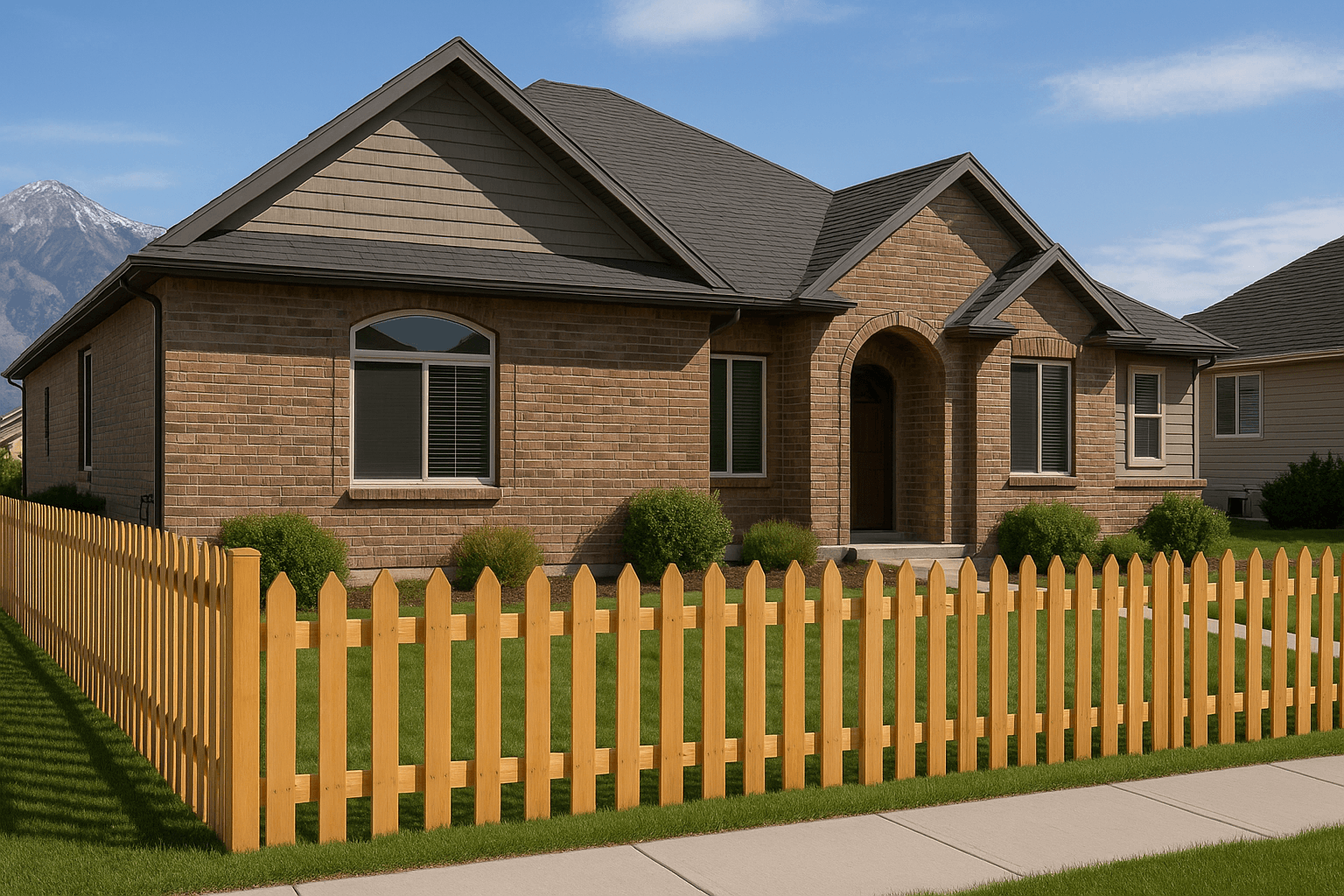
The 3-Foot Picket (36 Inches)
This is your classic, decorative “American Dream” fence. It’s strictly for boundary definition.
- Best for: Front yards, garden enclosures, and maximizing visibility.
- Pros: It feels open and airy. Neighbors can easily chat with you over the rail.
- Cons: It won’t stop a medium-sized dog, and it offers zero privacy.
The 4-Foot Picket (48 Inches)
This is probably the most common height we install here in Logan for backyards that don’t need total privacy.
- Best for: Keeping kids and average dogs contained while maintaining a view.
- Pros: It’s tall enough to be a physical barrier but short enough to not feel enclosed.
- Cons: A determined athletic dog can still clear this.
The Hybrid or Tall Picket (5 to 6 Feet)
Here is where things get interesting. A traditional picket fence at 6 feet can look a bit… intense. Like a barricade. However, custom picket designs or “shadowbox” styles with picket elements can work at this height.
- Best for: Backyards needing privacy or pool safety.
- Pros: High security and privacy.
- Cons: Can block sunlight and views; usually restricted in front yards by zoning laws.
Here is a quick breakdown to help you visualize it:
| Fence Height | Primary Purpose | Ideal Location |
|---|---|---|
| 3 Feet | Aesthetics & Boundaries | Front Yards / Gardens |
| 3.5 Feet | decorative + Minor Containment | Front/Side Yards |
| 4 Feet | Pet/Child Safety | Backyards / Side Yards |
| 6 Feet | Privacy & Security | Backyards Only |
The “Cache Valley Factor”
We aren’t building fences in Florida; we are in Utah. We have specific environmental quirks that should influence your height decision.
Let me explain. When winter hits Logan, the snow piles up. If you build a fence that is flush with the ground, or if you choose a shorter fence that gets completely buried, you are asking for trouble. Snow acts like a sponge, holding moisture against the wood. Even pressure-treated pine or cedar has its limits.
If you go with a shorter 3-foot fence, a heavy winter might make that fence disappear entirely under a snowbank. This makes it useless for keeping your dog in the yard during January. A 4-foot fence usually offers enough clearance to remain functional even after a good storm.
Also, think about the wind. We get some serious gusts coming through the valley. A taller fence acts as a sail. While picket fences allow air to pass through (which is great for wind resistance), the taller you go, the sturdier your post depth and concrete footing need to be to handle the load.
Zoning and HOAs: The Boring (But Necessary) Stuff
Honestly, this is the part that trips people up the most. You might have the perfect 4-foot fence picked out for your front lawn, but Logan City zoning ordinances—or your strict HOA—might have a different opinion.
Generally speaking, most municipalities limit front yard fences to 4 feet (sometimes 3 feet depending on visibility triangles near driveways). They want to ensure drivers can see pedestrians and other cars. If you put up a 6-foot wall right by the sidewalk, you create a blind spot.
Corner lots are especially tricky. If your house is on a corner, you have two “front” yards in the eyes of the city, and line-of-sight rules get very strict. Before we cut a single piece of wood, we always check the local codes. It saves you from the nightmare of having to tear down a brand-new fence.
Let’s Talk About Proportion
Have you ever seen a small, single-story cottage surrounded by a towering fence? It looks disjointed, right? Like the house is hiding.
The height of your fence should relate to the scale of your home. A sprawling two-story home can handle a taller, chunkier fence without looking overwhelmed. A smaller bungalow usually looks best with a 3 or 4-foot fence that complements its lower profile.
You also need to think about the picket spacing. The gap between the pickets changes the visual weight of the fence.
- Wide gaps: Make the fence look shorter and lighter.
- Narrow gaps: Make the fence look taller and more solid.
If you are worried about a 4-foot fence looking too imposing in a small yard, we might suggest widening the gap between pickets slightly to let more light through. It tricks the eye into thinking the structure is less massive.
The “Fido” Factor
We touched on this earlier, but it deserves its own section. If the main reason for this project is a dog, you need to be realistic about your pet’s athletic ability.
Small dogs like Pugs or Terriers? A 3-foot fence is usually fine, but you need to worry about the spacing more than the height. They will try to squeeze through the pickets rather than jump over.
Labs, Retrievers, and Huskies? A 4-foot fence is the bare minimum. Honestly, for Huskies, even 6 feet is sometimes just a suggestion to them. But for most family dogs, 4 feet is the sweet spot. It stops them from casually jumping over, but allows them to see out.
Pro tip: If your dog is a “patroller” who barks at everything they see, a picket fence (which has gaps) might actually encourage the barking because they can see the targets. In that case, you might want a taller fence with tighter spacing, or a different style entirely. But if they just like to sniff the breeze, pickets are perfect.
Material Matters: Does Wood Type Affect Height?
You might not think wood species matters for height, but it does when it comes to warping. The taller the board, the more likely it is to twist or bow over time if it isn’t supported correctly.
Using Cedar is a fantastic choice for our climate because it is naturally resistant to rot and tends to stay straighter than pine. If you are dead set on a taller picket fence (say, 5 feet), we need to make sure we are using high-quality rails (the horizontal backer boards) to keep those tall pickets in line.
For a standard 3 or 4-foot fence, you usually use two rails. Once you go taller, you absolutely need a third rail. This adds weight and cost, but it keeps the fence from looking wavy after a few seasons of Utah weather.
The Slope of Your Yard
Here is a curveball: your yard probably isn’t perfectly flat. Logan has plenty of hills and slopes.
When you install a fence on a slope, we have to decide between “racking” or “stepping.”
- Racking: The fence follows the contour of the ground. The pickets stay uniform in height relative to the grass. This looks smooth and is great for keeping pets in because there are no gaps at the bottom.
- Stepping: The fence sections are level, like stairs. This looks very architectural but leaves triangular gaps at the bottom of each section.
Why does this matter for height? Well, if you “step” a 4-foot fence down a steep hill, on the downhill side of the section, that fence might actually be 5 feet off the ground, while the uphill side is 4 feet. It changes the aesthetic completely.
Mixing Heights
Who says the fence has to be one height all the way around? It is becoming increasingly popular to mix heights.
You might do a charming 3-foot picket fence across the front of the house to boost that curb appeal, and then transition (or “taper”) up to a 5 or 6-foot fence along the sides and back for privacy.
This transition needs to be handled carefully so it doesn’t look abrupt. We usually cut the pickets at a diagonal angle where the two heights meet, creating a swoop that looks intentional and elegant. It gives you the best of both worlds: a welcoming front yard and a private backyard sanctuary.
A Note on Maintenance
Taller fences mean more surface area to stain or paint. It sounds obvious, but painting a 3-foot fence is a pleasant Saturday morning project. Staining a 6-foot perimeter fence is a full weekend commitment.
Since wood is a natural material, it needs love. UV rays here at high elevation can be harsh. A shorter fence is often easier to reach and maintain, which means it might actually look better in the long run because you won’t dread re-sealing it every few years.
Avoiding the “Spite Fence” Vibe
There is an old term called a “spite fence”—a fence built excessively tall just to annoy a neighbor. While you obviously aren’t doing that, accidentally blocking your neighbor’s view of the mountains with a tall picket fence can create tension.
Picket fences are inherently friendly. They are neighborly by design. Keeping them at a modest height (3 to 4 feet) usually preserves relationships better than putting up a tall barrier. If you genuinely need privacy, there are better styles than picket (like tongue-and-groove) that do the job without looking like a cage.
Making the Final Call
So, where does that leave us?
If you want the classic look and just want to define your space? Go with 3 feet.
If you have a dog or small kids but still want to see the neighborhood? Go with 4 feet.
If you have a unique landscape or security needs? Let’s talk about a custom height.
It is easy to get bogged down in the numbers, but try to visualize yourself living with the fence. Imagine backing out of your driveway—can you see over it? Imagine sitting on your patio—do you feel exposed or enclosed?
Sometimes, the best way to decide is to just stand in your yard with a tape measure. Hold it up to 36 inches, then 48 inches. You will feel the difference immediately.
Ready to Transform Your Yard?
Choosing the right height is just the first step. You need a team that understands the soil, the wind, and the zoning codes of Logan to make sure that fence stands straight for decades. We have been building fences in Cache Valley for years, and we know exactly how to balance practical needs with that perfect aesthetic.
Stop guessing and let’s get your project started. Whether you need a decorative border or a secure perimeter, we are here to help you get it right.